
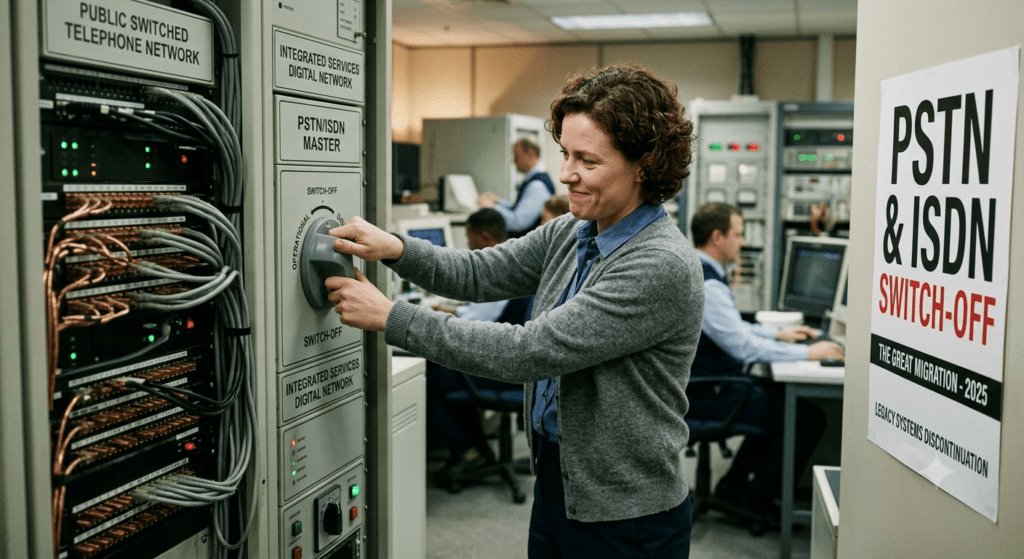
The PSTN switch off is one of the biggest changes to hit business telecoms in decades — and if your company still relies on traditional analogue or ISDN phone lines, it will affect you directly. In this guide, we break down exactly what the PSTN switch off means, when it’s happening, and the simplest way to prepare your business so you avoid any disruption to calls, alarms, or payment systems.
What Is the PSTN Switch Off?
PSTN stands for Public Switched Telephone Network — the traditional copper-wire infrastructure that has carried phone calls for over a century. Openreach (the UK’s national telecoms infrastructure provider) is retiring this network in favour of full-fibre and IP-based technology. This means all analogue and ISDN lines will eventually stop working, and every business will need to switch to a digital alternative such as VoIP (Voice over Internet Protocol).
This isn’t just a phone upgrade — the PSTN switch off also affects:
- Alarm systems and fire panels connected via analogue lines
- PDQ / chip-and-pin payment terminals
- Fax machines and older EPOS systems
- Lift and telecare emergency lines
- Legacy PBX phone systems
Why Is the PSTN Switch Off Happening?
Copper-based networks are expensive to maintain, increasingly unreliable, and unable to support modern data demands. As full-fibre broadband rolls out across the country, telecoms providers are shifting all voice traffic onto internet-based networks, which are cheaper to run, more resilient, and capable of supporting richer features like video, messaging, and integrations with business software.
Key Dates Businesses Should Know
Migration dates vary by region and provider, and exchanges are being switched off in phases rather than all at once nationally. Rather than relying on a single fixed date, businesses should:
- Contact their current line provider to confirm their local exchange’s stop-sell and switch-off dates
- Audit every device and system still connected via PSTN or ISDN
- Plan a migration well ahead of the deadline — not on the day it happens
Leaving migration too late is the single biggest risk. Once an exchange is switched off, any equipment still relying on it will simply stop working.
What Happens If You Don’t Migrate in Time?
If your business doesn’t move away from PSTN/ISDN before your local switch-off date, you could face:
- Complete loss of phone service (inbound and outbound calls)
- Alarm systems failing to communicate with monitoring centres
- Payment terminals unable to process transactions
- Compliance and safety risks if emergency lines fail
How to Prepare for the PSTN Switch Off
The good news: migrating away from PSTN is straightforward when planned properly, and it’s an opportunity to modernise your communications rather than just replace what you had.
Steps to prepare:
- Audit your current lines – list every line, its purpose, and what’s connected to it.
- Choose a cloud communications provider – look for a partner who can migrate lines with minimal downtime.
- Number porting – confirm your existing business numbers can be ported to the new system.
- Test connected equipment – alarms, payment terminals, and lifts may need separate upgrades.
- Train your team – a cloud phone system often comes with extra features worth onboarding staff on.
Why the PSTN Switch Off Is Actually a Good Opportunity
Rather than viewing this as a forced cost, many businesses use the PSTN switch off as the trigger to move to a full cloud communications platform — gaining mobile apps, call analytics, CRM integrations, and lower running costs in the process. If you’re weighing up your options, our guide on why businesses go cloud covers the benefits in detail.
How Curouip Can Help
Curouip helps businesses plan and execute a smooth transition ahead of the PSTN switch off — auditing your existing lines, porting your numbers, and moving you onto a modern cloud phone system with zero surprises. Get in touch with our team to book a free line audit before your exchange switch-off date arrives.
When is the PSTN switch off happening?
Openreach is phasing out the PSTN and ISDN network exchange by exchange. Businesses should check with their provider for their specific local switch-off date rather than relying on a single nationwide deadline.
Do I need to change my phone number?
No. In almost all cases, existing business numbers can be ported across to a new cloud or VoIP system, so customers can keep calling the same number.
What replaces PSTN and ISDN lines?
Most businesses move to VoIP (Voice over IP) or SIP trunking, which runs calls over an internet connection instead of copper cabling.
Will my alarm system still work after the switch off?
Not automatically. Alarm and telecare systems connected via analogue lines need to be checked and, in many cases, upgraded separately to a digital-compatible signalling method.
Is switching to cloud calling expensive?
Often it’s cheaper than maintaining PSTN/ISDN lines long-term, and it adds features like mobile apps, call recording, and analytics as standard.